20 December 2016
Woke up pretty early today for the mobile Aboriginal
Medical Service in Fuxing (the English translation of Fuxing is revival)
District, Taoyuan. Thanks to Dr. Sun for the lift and explanations. The car
trip took approximately 70 minutes, so we listened to the radio and heard that
President Tsai was also in Taoyuan and got hit by a fallen wooden board (but
not seriously injured)!
This is a very special medical team. At
8am, there was a car parked outside the Taoyuan Fuxing District Public Health
Center. The medical team placed boxes of medicines, the doctor’s bag, laptop,
and pathology collection materials in the car, in preparation for the various
mobile service locations. This service has been discussed in the media and
there is even involved with an Aboriginal TV program, Malusu Healthy Clinic!
The main population of Fuxing is the Atayal
people of the Taiwanese aborigines. This district was named “Revival district”
by the Aborigines on October 10, 1954, in celebration of the birthday of
President Chiang Kai Shek as well as the revival of this nation. Apparently,
this district has the highest proportion of Christians in Taiwan. Chiang
Kai-shek liked the region and built a Chiang Kai-shek residence there!
I saw many of my “first times” there. For
instance, this was the first time I saw a residential house with concrete
floor, and being in a medical vehicle with a loudspeaker broadcasting “the
medical team is here” when it enters a village. This was also the first time I
had close encounters with the aboriginal people. In the past I only see them in
dance shows, whereas here, the driver and 1-2 of the medical staff are
aboriginal people! The nurse says, the Atayal language has some similarities to
the Filipino language, whereas the Amis language has some similarities to the
Indonesian language. The driver just hunted a 100kg boar the day before and
carried it down the mountain! The medical service visited three service spots
and two residences. Many of the service spots are in buildings built in 1970,
so there was a retro feel to it. This is the first aboriginal region to use Wireless
Broadband Network, and we had high speed internet in all of the service spots.
When we open the laptop, we could access the patient’s medical records through
the national electronic records system. We could also enter the progress notes
and do prescriptions electronically. We could also access radiology documents
from PACS. In one of the service spots, the school nurse brought over many
children. The children seem to think the doctors have some sort of magical
powers, because one of the kid poked his head in and said “if you give me the
medicine syrup I will become well!”
However, the Taiwanese doctors seem to have
a very poor quality of life. They earn “points” instead of cash, and the points
to cash ratio fluctuates. Currently 300 points= NT270. There is also a limit to
the maximum income generated from a service, so you don’t necessarily earn more
if you see more patients than other doctors, but if you see too little
patients, you will earn a smaller proportion of the total amount. Some doctors
fight over doing death certificates because one certificate generates NT1000! I
admire the doctors who are willing to stay in Taiwan despite such poor quality
of life.
More photos:
21 December 2016
Woke up in the morning in attempt to do a “groundbreaking
prayer”, but it didn’t seem that “groundbreaking”, then went into the GP clinic
at Mackay for a little while. I didn’t have much to do so and went into the GP
office. Suddenly a group of Santa Clauses barged into the office, started
singing a Christmas carol and gave me some candies! I had lunch with a V5 GP. I
asked her if she’s classified as a young V or an experienced V, she said she’s
neither. Experienced V is V7 and above! I learned that she grew up in the US,
but moved back to Taiwan during university because her family wants her back.
People who grew up overseas deciding to return to Taiwan due to family seem to
be a common occurrence. On the topic of the shortage of doctors in Taiwan, she’s
heard that the internal medicine department in Mackay hospital was unable to
recruit any residents for 2017, so the consultants have to do the residents’
jobs next year!
It was winter solstice that day so Rui Rui
arranged some exciting surprises at the Barnabas School of Mission such as
Ferrero Rocher flowers with bible verse cards and Glutinous rice dumplings in
sweet soup. The topic of today’s class was on the Silk Road.
22 December 2016
This was my first visit to a private GP
clinic in Taiwan for educational purposes. It made me realize that there is
great competition and pressure here. I saw some machines which I’ve never seen
before:
The throat steamer: This clinic lets people
inhale peppermint mist. Most clinics just use normal saline.
The throat spraying and mucus suction
machine: The throat spray gives temporary relief for sore throat. The mucus
suction relieves the symptoms of nasal congestion temporarily.
Many people know that without these
gadgets, the viral infections get well on its own. However, if you don’t have
these gadgets, people don’t come to your clinic!!
There is also a rapid test for influenza
A/B infection. The results come out within ten minutes! We don’t have any of
the above in Australia. In Taiwan, people with cold and flu are expected to
wear masks, and the doctors educate patients to wear masks if they see a cold
and flu patient not wearing one. In Australia, we don’t expect cold and flu
patients to wear masks.
GPs are also expected to know how to do and
report on ultrasounds, be it breast or abdominal ultrasound, they have to know
at least one. Dr. Lin said she chose to do breast ultrasound because it’s
easier to do, and female patients prefer female doctors for this. This probe
for breast ultrasound can also be used on the thyroid, which is another easy to
read region.
Private GP clinics usually employ a
pharmacist, because some income can be generated from the medicine.
Another interesting difference is, there
are many types of “specialists” in Taiwan, and not all “specialties” are
officially recognized. For instance, obesity specialist is a specialty that’s
not officially recognized. Furthermore, geriatrics and palliative care are
specialties done by GPs, not physicians.
Some GPs don’t like to work in hospitals
because they have to do so much paperwork, administration, teaching and
research that they do not feel like a clinician. The GP also have to go for
“company visits”, where the company asks a doctor to come to their company’s
clinic to examine their employees. I don’t think we got this in Australia. The
hospital GPs are also required to go for home visits, nursing home visits, and
rural visits. In Australia, city GPs can choose not to do any of the above
(paperwork is the exception)!
Private clinics also have to be careful
about computer viruses, which can destroy the patients’ electronic records.
Techniques are needed to attract customers. For instance, in the clinic I
visited, there is a children’s play area open to all children, even
non-patients. This brings more people to the clinic, and some children even
specify that “I want to go to the clinic with the toys” when they have to visit
a doctor.
Visited my grandfather during lunch time
and saw that he was wearing old pajamas with a big hole. Both my grandfather
and grandmother are hoarders. Not sure about the psychological mechanism of
this, but it seems to happen more easily to people who lost or got abandoned by
their parents at a young age! In the afternoon I caught up with a church
brother who brought me back to Christ in NZ, and realized things had been
especially tough for him in the last few years. Perhaps God may use him in a
very special field? In the evening I had dinner with group G from the Israel
tour + Haifa from ICEJ and had a joyful time. However, I’ve been feeling sleepy
easily these days; don’t know if it’s due to a poor quality of sleep or a health
deterioration in Taiwan. I seem to experience a health deterioration when I
stay in Taiwan for prolonged periods. In my childhood, my health was poor when
I was still living in Taiwan but when I left the country my health became very
good.
23 December 2016
Today we went for home visits, and realized
the community service office is next to where I used to live in Taiwan during
my childhood before I moved out of the country. The GP and the nurse got into a
taxi which took us to the different locations. This is quite different from
Australia because I don’t think the GPs in Australia do home visits with a
community nurse from a public hospital. I only know that GPs do home visits
alone. And community nurses do home visits alone too. This could be because GPs
in Australia gets out of touch with the hospital system pretty early on (as
early as PGY3). So I think more can be done in linking Australian GPs with the
hospital system. In Taiwan, certain criteria have to be met in order to qualify
for the home visit service: Barthel Index<60, NG tube, urinary catheter,
etc. The doctor’s bag’s got many little tools such as the wrist BP machine, and
icebox for vaccines, safety needles, etc. The accompanying nurse do some of the
procedural tasks such as giving vaccines, changing NGT, urinary catheter, etc.
The GP department meeting was on the topic
of Forxiga and the drug rep provided lunch. Very few doctors attended. I wonder
if it could be because there was a talk on Jardiance a few days ago + free
lunch. There were nine lunch boxes leftover at the end of the meeting so I
brought two boxes to my grandfather who lives next to the hospital and my uncle
who was caring for him on that day.
In the afternoon I spoke with the hospital
psychologist about doctor-patient relationships. He showed me a video about
empathy:
The main point is, we have to beware of the
differences between our worldview vs the patient’s worldview. For instance, the
statement “xx cancer stage 1” means different things to the doctor vs the
patient. The doctor may have seen many cases of “xx cancer stage 1” and know
from experience that there is a high cure rate. However, as soon as the patient
hears the word “cancer”, he/she may think he/she is dying. So the doctor always
has to ask the patient how much he/she understands repeatedly. The patient can
experience certain emotions, and we can describe what we observe, eg. “you seem
sad”, and give the patient some space for further expression. Sometimes the
doctors can be in such a hurry to provide information that he/she misses the
patient’s emotions and forget to double check whether the patient is capable of
absorbing such information under these emotions. Other times, we are so quick
to offer some silver-linings, but these rarely help. Listening and accompanying
doesn’t necessarily change what will happen next (eg. Terminal conditions), but
at least it creates a sense of connection. However, those who frequently offer empathy
have to learn some sort of self-regulation, because it is easy to burn out when
one drops into another person’s hole.
24 December 2016
I went with a medical team from Mackay Hospital
up the mountain for the mobile Aboriginal Medical Service in Jianshi Township. I
greatly appreciate chief resident Dr. Bai’s efforts in arranging a visit coinciding
Christmas, because the atmosphere was very special! There was a physician, two
nurses, one pharmacist and one driver on the medical team. One nurse brought
her daughter along. The lunch box was very tasty. We stopped over in Guanxi and
the Frog Rock. We also stopped over at Tbahu Church to post our medical service
poster. We had to go to Xiuluan Public Health Center to get the paper medical
records for people in the region because unlike Fuxing district, the electronic
records are too difficult to access due to unstable internet connection. The
road was extremely windy so I thank the Pharmacist for giving me some anti-motion
sickness medications. Around 5pm, we arrived at the first service spot,
Xinguang Catholic Church. As soon the equipment was set up, the ceiling lights
lost power! So we did a home visit and went for dinner. When we returned, we
shifted the equipment to a much smaller room where the ceiling lights were
working. Later, someone turned off the lights for the Christmas ornaments and
the ceiling lights worked again. There were very few patients because it was
Christmas Eve and according to the nurse, 100% of the villagers were Christians
(in Xinguang Village, 2/3 Catholics and 1/3 Presbyterians, in Cinsbu Village,
100% Presbyterians) and they all went for Christmas celebrations! After the
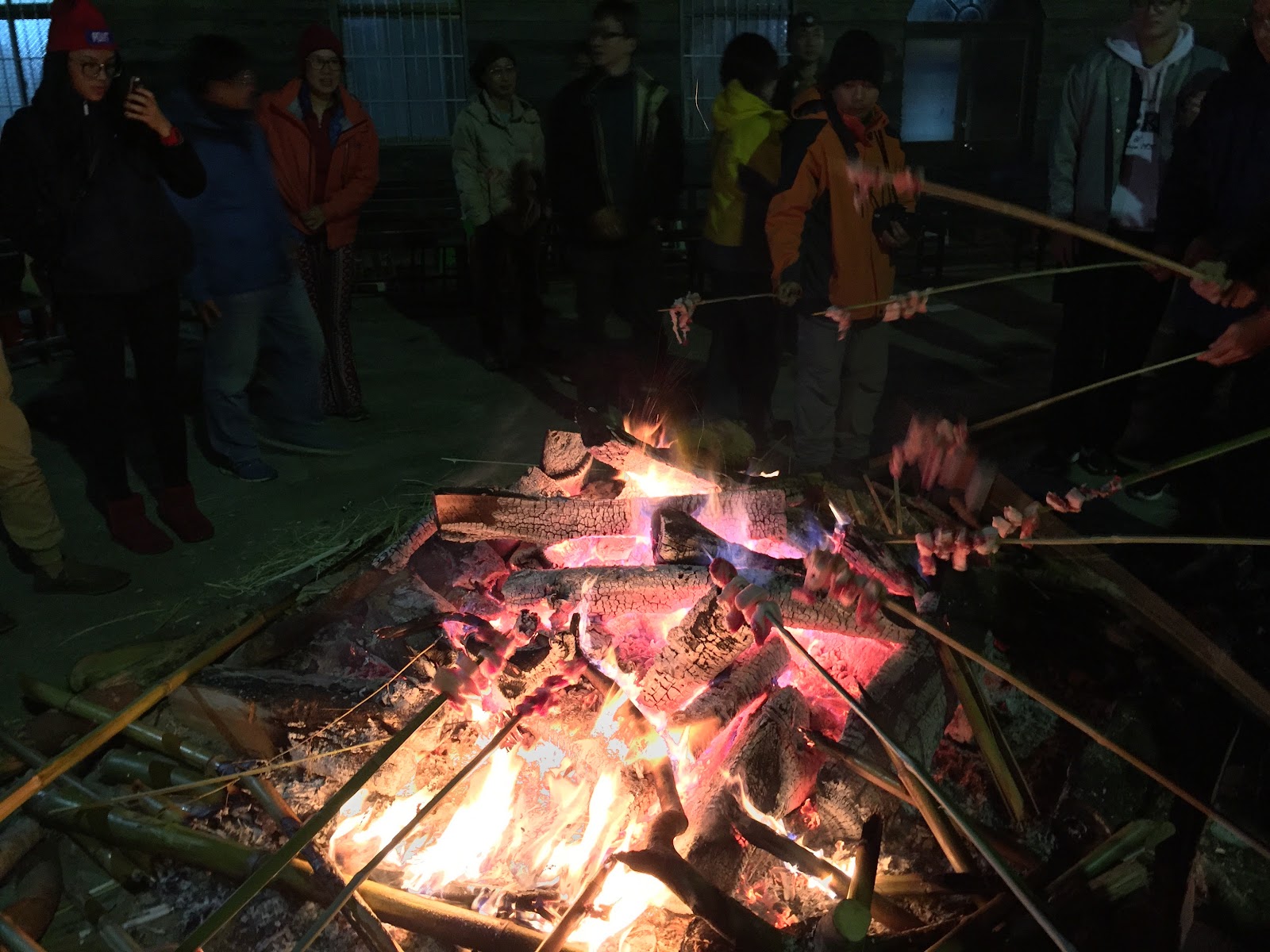
clinic session, we joined the Christmas Eve celebrations at Cinsbu Church,
which had performances and BBQ in the campfire. Even the four year old village
kid was cooking the BBQ in the fire. Our driver cooked a tasty pot of fish ball
soup for the team and the church’s pastor. The medical team chatted with the
pastor and we started talking about the snow disaster in January where the area
suddenly snowed unexpectedly. Three Mackay service teams were stuck on the
mountain for a week. The pipes and water heaters all cracked and broke.
Villagers had to scoop up snow and cook it in the fire to obtain water. It took
a month before the pipes got fixed. This disaster created more damage than a
typhoon. The food supply got cut off so food had to be delivered up the
mountain. More details about the disaster could be found in:
Christmas is peak tourist time for this
region so all the motels were full. We slept in the church, which was actually
quite comfy.
25 December 2016
Finally saw the true face of the Cinsbu
Church in the morning! It is aqua blue, very beautiful, with an aboriginal
theme to it. We ate breakfast, which included the yummy high mountain cabbage,
which tasted very sweet. Then we had a short walk at Xinguang Primary School
before turning to the Cinsbu Church for clinic. We had >30 patients in the
morning. The most common conditions are hypertension, liver disease and gout.
We met the parents of pop singer Landy Wen! Mr Wen even gave us a box of honey
cake! I also get a taste of Mackay Hospital’s Christmas plum cake, which tasted
really familiar because I think ate it in kindergarten either when I went to
Sunday school at SuangLien Church, or in the Christian preschool I attended!
This was the first time I attended a Taiwanese Aborigine Sunday service! After
the service we had a Christmas day feast and the whole medical team was
invited. It was very yummy and we ate some special aboriginal delicacies such
as smoked fish and smoked pork!


More photos:
After returning for the mountain, I had
dinner with a friend and joined the Hanukkah celebration at TOD! The theme of
the evening was on how we are to be like Maccabee, a group of hammers (the
Hebrew Maccabee=hammer)! And the judge in the court also uses the hammer. They
even handed us hammer necklaces! More on the history of Maccabee:
26 December 2016
My mom just arrived in Taiwan from Ireland,
and a hairdresser’s cut her hair into the “ghost in the shell style”! Recently
my middle school friend also had this haircut. My mom didn’t even know she’s
got the same haircut as Scarlett Johansson in an upcoming movie. My maternal
side of the family, including my mom, all her sisters, my grandmother, and an
uncle in law and I flew to Taitung. There wasn’t much happening on the first
evening, just going into hot spring spa, getting massage, and eating buffet
dinner.
Meanwhile, the Xiuluan area of the Jianshi
Township, which I only returned from a day ago, experienced a severe landslide
today. It had been sliding all week but became worse. The villagers are worried
because not only is there an elementary school in the path of the slide, but
the “Mackay Clinic” too. This place is on the path to the tour attraction site
of Smangus. The landslide is not only a threat to the villagers’ farms, but
also their lives, and many are considering moving out of the village. This is
also the site of a river that goes into Shimen Dam, and if this path gets
obstructed, a landslide dam will form!
27 December 2016
The weather was pretty cold. First we went
to Shiauyeliou. Then we visited a place of geographical miracle called “Water
Running Upward” where water flows upstream, and some tourists from China
started taking their shoes off and soaking their feet in the water, while
others picked the flowers and threw the petals into the stream. We went to the Dengxian
Bridge Recreation Area and saw many wild monkeys. Suddenly, a male monkey stood
up and raped a female monkey. The female monkey punched the rapist and escaped
to another monkey and started combing his fur and picking his nose. My aunt was having her photo taken when the female monkey started walking to the other monkey and she got really scared! I couldn’t
understand these monkeys. Some people started feeding the monkeys and a large
group of them climbed down from the cliff to eat. Then we went to Sansiantai it
was really windy, and the sea waves were violent. We went to Jialulan
recreation area and saw some fishes.
We had seafood lunch at Chenggong harbor.
We had pork buns at Donghe, coffee at Jinzun, and saw some black slithery
fishes at the Shanyuan-fushan fish recovery area. We had dinner at a popular
local restaurant. Then we celebrated my grandmother’s lunar birthday and ate
lots of Sakya (sugar-apple).
28 December 2016
The weather remained cold, and it rained
intermittently! We went to Chu Lu Ranch and saw a tiny male pig licking the
tourists’ hands ferociously. Then he went on to rape a female pig twice his
size, and the angry female pig roared! He then went on to rape a second
gigantic female pig! It was pretty disgusting to look at, enough to produce
PTSD. However, that’s the way animals are naturally.
In the afternoon we went to Mr. Brown
Avenue for bike riding and viewing the “Takeshi Kaneshiro” tree. This tree is
pretty tough; it was blown over by a typhoon in 2014 and planted back. We rode
on an electrical quad cycle, with me driving one cycle and my uncle in law
driving another. Theoretically cars shouldn’t enter Mr. Brown Avenue but we saw
many cars come in. Then we ate some tofu desert, bought some Sakya, and
returned to Taipei! Installed Facebook and Line onto my grandmother’s smart phone to make it more convenient for her to download photos and she was pretty happy!
29 December 2016
Visited the Tamshui nursing home and realized
that there are many elderly care facilities around. This type of nursing home
is different (even has a different Chinese term for it) from the nursing home I
visited on 14 December in that this nursing home is more like a hospital and
ran by the nurses whereas the other nursing home is more like a home and ran by
social workers. Most of the residents of this nursing home are bed ridden and
intubated, while most of the residents of the other nursing home are without
any major illnesses and still mobile, even those with dementia. The doctor here
showed me someone who suffered from the Purple Urine Bag Syndrome (PUBS), and
this was the first time I’ve seen someone with this condition!
The patients on the second floor of this
nursing home are not as sick medically, but many suffer from dementia, so many
activities are arranged to stimulate their brains. The patients on the third
floor of this nursing home are very sick, bed ridden and intubated. They remind
me of my maternal grandfather who passed away when I was in middle school
because he spent the final two years of his life like this.
I had lunch with an internal medicine
attending/consultant/VS. I met her 11 years ago when we were exchange students
doing our electives at NTUH during medical school. The last time I caught up
with her was nearly ten years ago. Life seems good for her in Taiwan. She
mentioned that Family Physician (=GP) is now one of the more competitive specialties
in Taiwan, and Mackay’s Family Physician training is the most competitive of
all, because they do not need to admit inpatients whereas other training
programs do. Then she suddenly asked me how much I earn in Australia. This was
the first time I really sat down and did a proper calculation I earned and realized
that I have given the Mackay doctors the wrong figures several weeks ago when I
was asked the same question! Because previously I thought all of my income will
be taxed at 45%. In reality, the first $180,000 is taxed at 30.1%, and then 45c
for each $1 over $180,000. After this discussion I finally realized why the
doctors in Taiwan are so pessimistic and wanted to do cosmetic medicine.
However, it may be a bite of a challenge to do cosmetic medicine for your whole
career, unless you’re someone who looks really young for your age. And a doctor
cannot be too unattractive physically if he/she wanted to go into cosmetic
medicine because no one would believe that an ugly doctor can “cure ugliness”…
Although income doesn’t mean everything
because we should also take other factors into consideration such as family, a
sense of mission and contribution to the society, etc… but the difference
between Australia and Taiwan is just too great! If I wish to do something for
Taiwan, I might choose to go on some sort of short mission trip out of my own
pockets, or just
encourage my Taiwanese doctor friends to form some kind of organisation to
impact on the policy makers in Taiwan.
In the afternoon the superintendent of the
Taipei Hospital, Ministry of Health and Welfare, presented the completion
certificate to me. I asked the TIHTC worker what is the goal of this exchange
program, and the reply seems to be along the lines of the promotion of Taiwan’s
diplomatic space in the medical arena. This exchange program commenced in 2002,
and they sent a notification letter to the Taipei Economic and Cultural Offices
around the world annually. However, my mom (a diplomat) and I never knew about
this program. Nevertheless, I can say that I benefited quite a lot personally,
because this gave me the opportunity to see how the work environment is like as
a doctor in Taiwan without actually having to apply for a job in Taiwan. It
also benefits my relatives in Taiwan for me to gain a greater understanding of Taiwan’s
healthcare system. It was very interesting for me to see how they addressed the
rural medical workforce shortage using mobile medical teams, which is quite a
different strategy from Australia, where the government uses certain policies
to force overseas doctors to work in rural areas. I also gained more in-depth
insight into the current affairs in Taiwan.



30 December 2016
This was my last day in Mackay. I sat in
with A/Prof Hwang, who
practiced medicine for 30 years. She is promoting a type of dieting program for
the patients and her son wrote an android app to help patients keep track of
their diets. Interestingly she also did acupuncture on some of the weight loss
patients. At noon, the head of department of Mackay Family Medicine shared with
us the history of this department, which is celebrating its 30th
anniversary since its establishment. This year it is still performing extremely
well (ranks 2nd in the 2016 Family Medicine Training program
nationally). However, the new Family medicine trainees will need to work as
residents in the general medicine wards in 2017 for 5 months (the hospital is
really short-staffed in internal medicine)! Right before I left, the final words
spoken by the Chief Resident was, “Don’t be a doctor in Taiwan, the situation
is too sad here…” Yes, I think I will continue to work hard in Australia
(unless I hear God speak to me in an audible voice, “Yvonne Wang, go to Taiwan
to practice medicine”!)
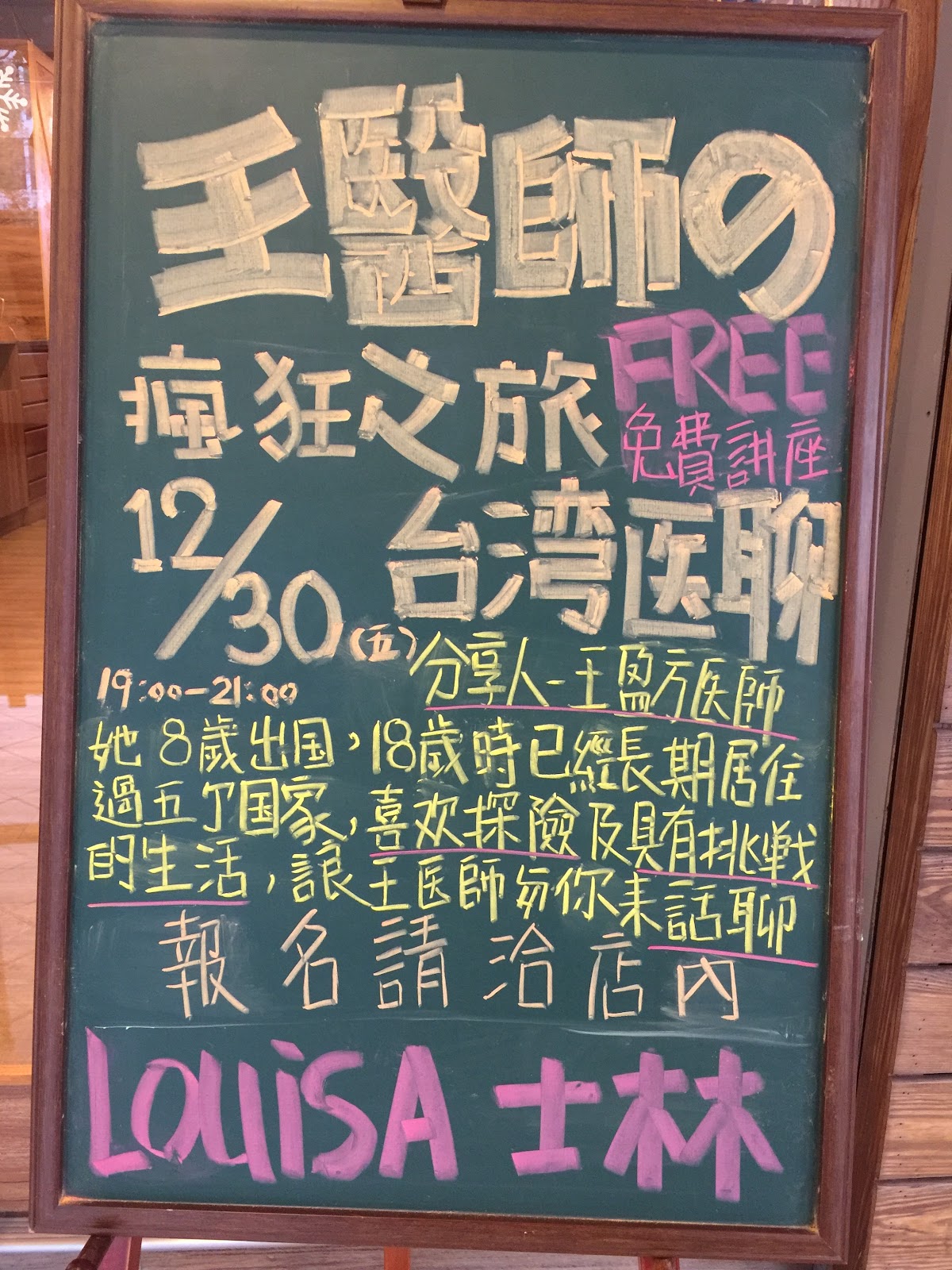
In the evening, I was invited by a friend
to give a talk in a coffee shop she works at. Something pretty terrifying
happened. When I was waiting for the MRT, I heard two females speaking to each
other in a South-East Asia language (ie. Philippines/Malaysia), and felt my
back pack being touched, so I turned around immediately because I am afraid
they are pickpocketing. When I got to my destination and had to take out my wallet
to buy a coffee, the wallet was not in my bag! So I thought it must’ve been
stolen and went back to the MRT station for police assistance! Of course, there
was a possibility I didn’t even bring my wallet out that day, but the
possibility was very low because I always remembered to bring my wallet. So I
ended up stuck with the police for the whole afternoon. The police and I looked
at the MRT security footage and saw the two behind me. It looked like they were
touching my bag but then there was somebody blocking so we couldn’t tell if
they actually took anything. However, the consequence of losing the items in
the wallet will be too severe so I made multiple phone calls to report my IDs
and credit cards as missing. I still didn’t finish sorting out everything when
I went to give the talk in the coffee shop, so I went to the police station
again after the talk, and it took until midnight before I got back to the dorm,
and that was when I found my wallet! I guess the friend who organized the talk
was probably close to a nervous breakdown that day and she helped me out by
buying dinner for me and sending an intercession request! But I guess this was the
best outcome; better than the wallet really being stolen. Besides, the way
those two women touched my bag were really suspicious! It was great catching up
with some friends that evening! One of my friends was especially helping in accompanying
me when I was with the police.


31 December 2016
Left the dorm in the morning, bringing
everything to my grandmother’s house! However, due to the psychological trauma
of the previous day, my head was aching all day! At noon I had a family feast
with my maternal relatives and went to friend’s luxurious house for dinner. It
was a day of grace.